ABSU, UBPO and ex-NDFB body press for 125th amendment bill, plan 2 lakh-strong rally in Kokrajhar in December
New Delhi, Nov 21: Three key Bodo organisations on Friday staged a sit-in protest at Jantar Mantar here, demanding time-bound implementation of the 2020 Bodo Peace Accord and early passage of the long-pending 125th Constitutional Amendment Bill aimed at strengthening Sixth Schedule councils in the Northeast.
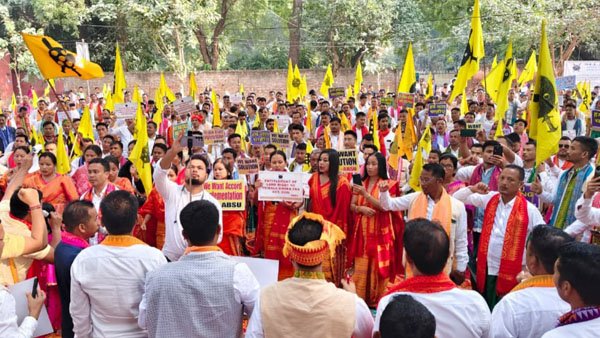
The All Bodo Students Union (ABSU), United Boro People’s Organization (UBPO) and Ex-NDFB Welfare Association held a three-hour demonstration as part of a two-day “national movement” in the capital, after convening a seminar at the Constitution Club attended by representatives of 10 Sixth Schedule councils from across the region.
The groups said that while the signing of the Bodo Accord had ushered in “a new dawn of peace and stability” in Assam’s Bodoland Territorial Region (BTR), several key clauses remained unimplemented nearly five years on, raising doubts over the government’s commitment to its own timelines.
ABSU president Dipen Boro said the Centre must now match the “patience and faith” shown by Bodo stakeholders with visible action on the ground.
He called for immediate tripartite talks between the Union government, the Assam government and ABSU to review and fast-track pending clauses of the accord, warning that inaction could undermine the credibility of the peace agreement.
The organisations flagged that they have taken part in more than a dozen tripartite review meetings with the Centre and the Assam government and have met the Union home minister multiple times, but have seen “slow progress” on crucial commitments.
As the next phase of their agitation, they announced a mass gathering in Kokrajhar in December 2025, where they expect around two lakh people to participate.
At the heart of Friday’s protest was the demand for passage of the Constitution (125th Amendment) Bill, 2019, which seeks changes to Article 280 and the Sixth Schedule to enhance the financial and administrative powers of autonomous councils in Assam, Meghalaya, Tripura and Mizoram.
Bodo leaders argue that without this legal backing, the Bodoland Territorial Council (BTC) and other councils cannot function with genuine autonomy.
The memorandum submitted by ABSU and its allies also renewed long-standing political and administrative demands linked to the Bodo Accord. These include increasing BTC constituencies to 60 without disturbing the existing tribal reservation pattern, transferring additional subjects listed under Annexure I of the accord, and forming village and municipal councils with constitutional backing to deepen grassroots self-governance.
On the fiscal front, the organisations reiterated their call for direct funding to BTC and other councils through provisions under Article 280 and Article 275(1)(a) of the Constitution.
They said predictable, assured devolution of funds was essential if peace accords and autonomy arrangements in the Northeast were to translate into tangible development outcomes.
The Bodo bodies also pushed for long-pending social and legal safeguards. Key demands include granting Scheduled Tribe (Hill) status to Bodo-Kachari people in Karbi Anglong and Dima Hasao, giving full-fledged status to the Boro Kachari Welfare Autonomous Council by notifying remaining villages and holding delimitation and elections, and provincialising schools and colleges within BTR as well as Bodo-medium institutions outside the region.
They further sought inclusion of additional tribal-majority villages from Sonitpur, Biswanath and areas adjoining the southern part of BTR, land rights for tribal communities under the Forest Rights Act, 2006, and withdrawal of pending cases along with the release of remaining former NDFB cadres, coupled with ex-gratia for families of those described as “martyrs” of the movement.
Underscoring the development plank of the accord, the organisations pressed for full implementation of a ₹1,500-crore special package promised for the BTR.
This includes a proposed Upendranath Brahma Central University, an Indira Gandhi National Tribal University regional campus, a National Sports University, an Organic University, a North East Regional Institute of Medical Science, a National Institute of Technology, a national stadium, a hotel and tourism management institute, a veterinary college and hospital, SAI centres in Udalguri, Baksa and Chirang, additional Jawahar Navodaya Vidyalayas, and the Majbat–Holongi highway.
Leaders said the Jantar Mantar protest was intended to remind the Centre that unfinished commitments in peace accords in Assam and the wider Northeast could erode trust if they remained unaddressed.
They stressed that while armed conflict in Bodoland had ended, a “just and timely” implementation of the Bodo Accord was essential to consolidate peace and meet the aspirations of tribal communities in the region.


